How Long After Drinking Can You Drive?
There is no single number of hours that works for everyone.
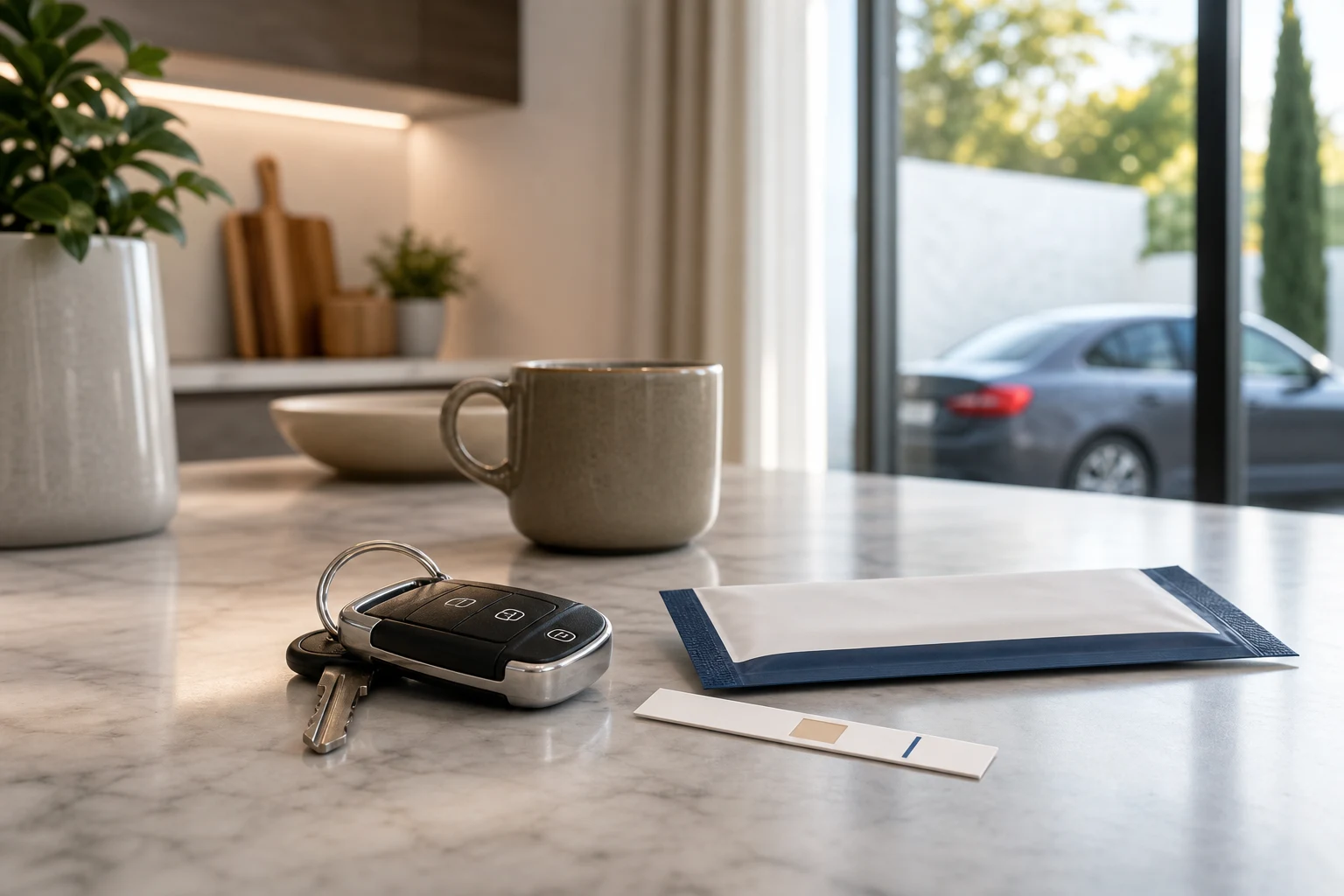
“I waited two hours” or “I slept, so it must be fine” are not reliable rules. Your body breaks down alcohol mainly through the liver, and that takes time. The timing depends on how much you drank, how quickly you drank, your body size, food, sleep, medication, general health, and when the alcohol reached its peak in your bloodstream.
The safest plan is to decide before drinking that you will not drive afterward. A taxi, public transport, walking distance, a sober driver, or staying overnight is more dependable than trying to calculate your alcohol level later.
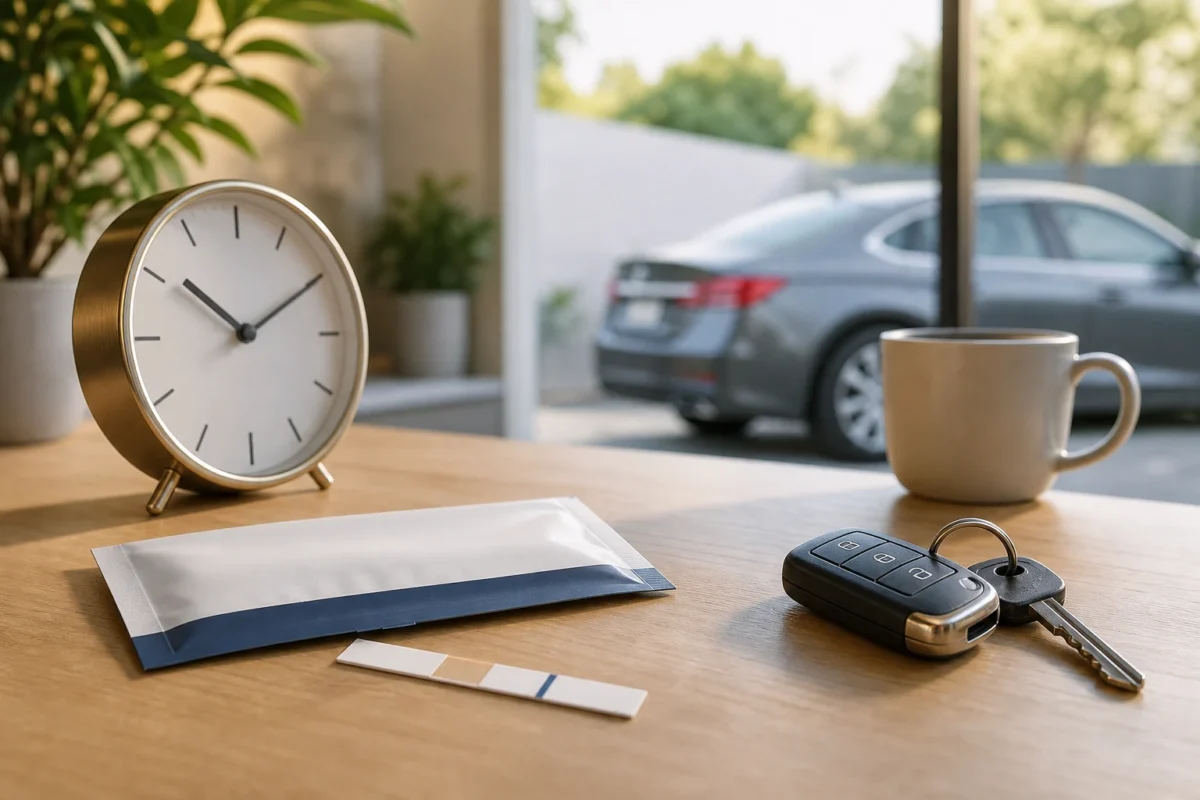
Saliva alcohol self-check products such as AlkoSafe can support personal awareness, especially before leaving home or the morning after. But a self-check result never replaces an official breath test, a blood test, local traffic law, employer procedures, or medical advice.
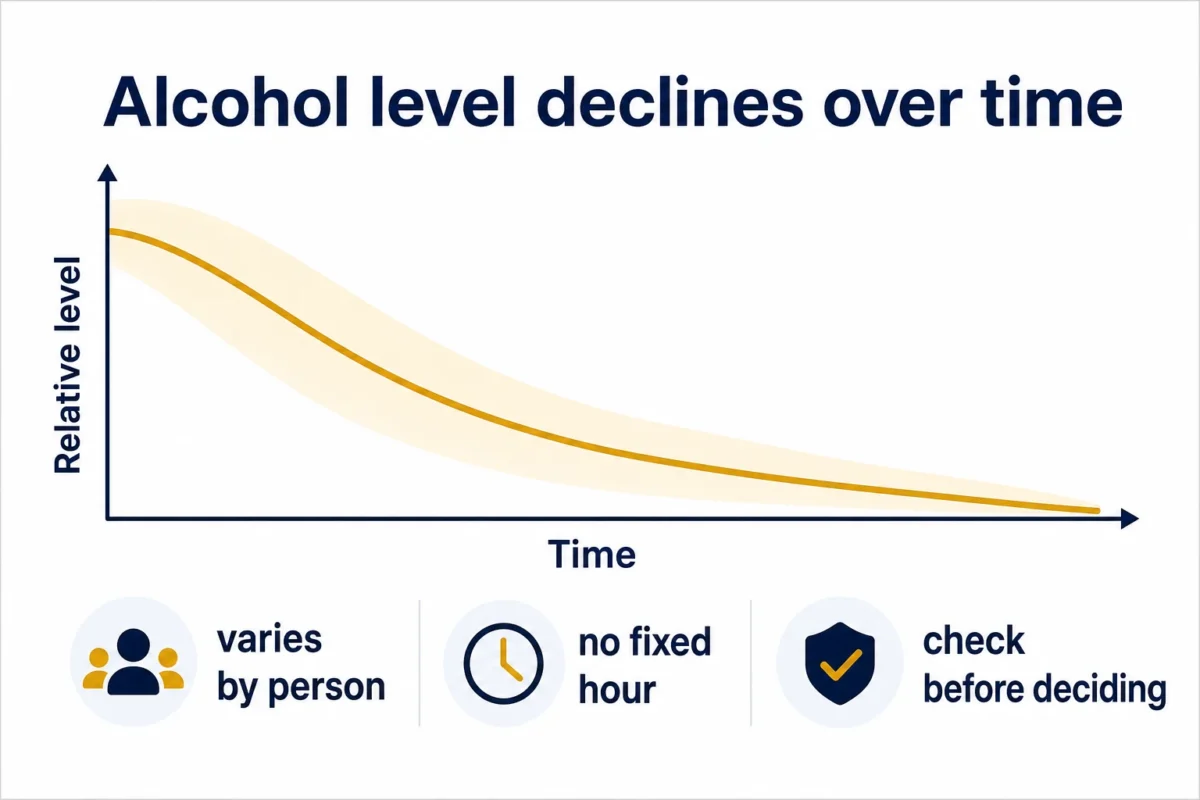
Why a fixed number of hours is misleading
Alcohol does not leave the body all at once. In forensic toxicology, blood alcohol elimination is often discussed in a broad range of about 0.10 to 0.20 promil per hour, with an average near 0.15 promil per hour for many moderate-drinking situations. That is only a rough range, not a personal guarantee.
Two people can drink the same amount and show different alcohol levels later. The same person can also get different results on different days.
Important factors include:
– The amount of alcohol consumed
– The strength and size of each drink
– How quickly the drinks were consumed
– Body weight and body water
– Whether food was eaten
– Tiredness and lack of sleep
– Liver health
– Medication and alcohol interactions
– The timing of any test after drinking started or stopped
This is why questions like “How long after one beer can I drive?” or “How many hours after wine is it safe?” cannot be answered with one universal number.
The morning after can still be a risk
Many people assume that if they slept, showered, and feel normal, the alcohol is gone. That can be wrong.
Sleep may help you feel rested, but it does not speed up alcohol elimination. If drinking continued late at night, the amount was high, or the session lasted several hours, measurable alcohol can still be present the next morning.
Morning-after risk is higher when:
– Drinking continued late.
– The exact number of drinks is unclear.
– Strong drinks or cocktails were involved.
– You relied on food to “balance it out.”
– You are tired, sleep-deprived, or taking medication.
– You judge only by how you feel.
Feeling sober does not prove that your alcohol level is low or that your driving performance has returned to normal. Alcohol can affect judgement, attention, coordination, and reaction time, which matter most when something unexpected happens in traffic.
Coffee, showers, food, and exercise do not clear alcohol faster
Coffee can make you feel more awake. A cold shower can make you feel refreshed. Food may settle your stomach. A short nap may reduce tiredness.
None of these meaningfully speeds up the liver’s alcohol breakdown. Turkey’s official traffic guidance also warns that coffee, exercise, and naps do not accelerate alcohol elimination; the body needs liver metabolism and time.
The key distinction is simple: feeling better is not the same as being alcohol-free.
What are the alcohol limits in Turkey?
According to public information from Turkey’s Traffic Presidency of the General Directorate of Security, alcohol limits are treated differently by driver type:
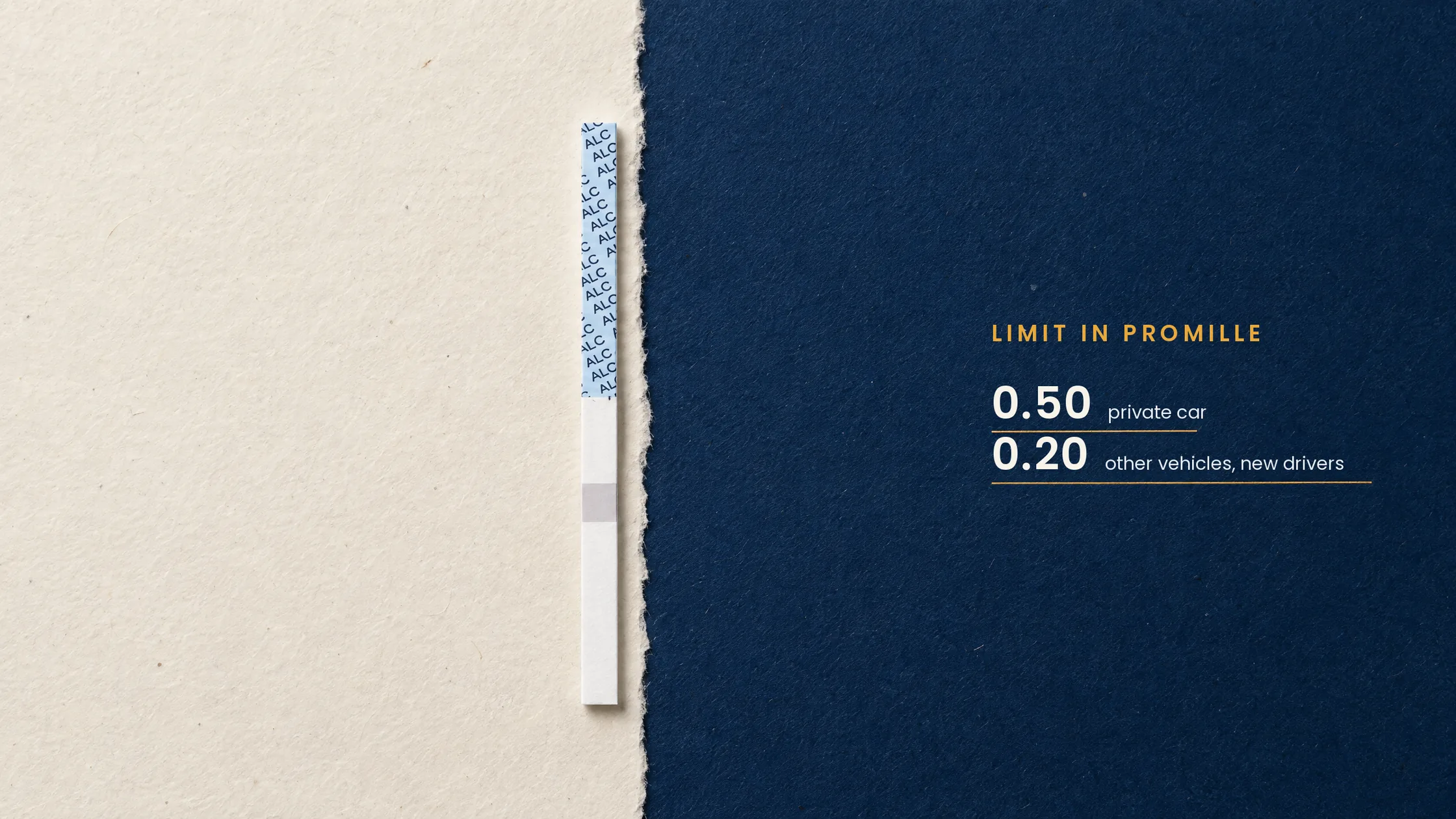
– For private car drivers, the legal alcohol limit is 0.50 promil.
– For drivers of vehicles other than private cars, the legal alcohol limit is 0.20 promil.
These numbers are not a safety guarantee. The same official source states that no alcohol level should be considered safe for driving, and that being below a legal limit may prevent a traffic penalty but does not guarantee life safety. It also notes that negative driving effects can increase from around 0.2 promil.
This distinction matters for AlkoSafe because the product’s 0.2 promil threshold is relevant for personal risk awareness and lower-tolerance driver groups. But it must not be read as a legal green light. A self-check result does not mean that the law has cleared you or that driving is a good decision.
Where AlkoSafe fits into the decision
AlkoSafe is a saliva alcohol self-check product designed for personal awareness. The strip helps detect alcohol in saliva above a defined threshold and is intended for a quick reading.
What it can do:
– Add a personal check before leaving home.
– Help identify a morning-after risk signal.
– Support more cautious planning for driving, work, family, or fleet settings.
– Encourage a clear decision not to drive when any colour change or uncertain result appears.
What it cannot do:
– It is not an authority-grade BAC value.
– It does not replace a police breath test or blood test.
– It does not provide an exact BAC/promil value.
– It is not positioned as legal evidence.
– A negative result is not driving approval.
Use AlkoSafe as a personal pause-and-check tool, not as a product that grants approval.
How to use saliva self-checks responsibly
Alcohol residue in the mouth can affect saliva alcohol testing. Product instructions should always be followed carefully.
General principles:
– Follow the waiting time and use instructions on the product.
– Do not test immediately after eating, drinking, smoking, chewing gum, using mouthwash, or using mouth spray.
– Use the strip for the correct time window.
– Read any colour change within the stated reading window.
– Do not interpret an unclear, faint, or unexpected result as “all clear.”
– If the result is positive or uncertain, do not drive.
The practical rule is strict: if there is doubt, do not drive.
How reassuring is a negative result?
A negative self-check can be a personal signal that alcohol was not detected above the test threshold in saliva. It does not, by itself, mean:
– You are officially below the legal limit.
– Your driving ability is fully restored.
– A police test would show the same result.
– You can drive in every situation.
Use it as one part of a broader decision:
1. Did you drink alcohol?
2. How much did you drink, and when?
3. Are you tired, sleep-deprived, ill, or using medication?
4. Do you feel fully alert?
5. Is there any colour change or uncertainty in the test?
6. Is there a safer transport option available?
If any answer creates doubt, not driving is the better decision.
The best plan is made before drinking
Alcohol affects judgement as well as reflexes. After drinking, people may underestimate risk and overestimate their control.
A better plan is made before the first drink:
– Do not take the car.
– Choose a sober driver.
– Plan a taxi or ride app.
– Accept in advance that the car may need to stay parked.
– Avoid alcohol if you must drive early the next morning.
– For workplace, fleet, or family use, treat self-checks as part of a prevention culture.
This is where AlkoSafe is most useful: it supports more responsible decisions before a small uncertainty becomes a serious risk.
Quick summary
- There is no universal number of hours after drinking that makes driving safe.
- Alcohol elimination varies by person and situation.
- Sleep, coffee, showers, food, and exercise do not meaningfully speed up alcohol clearance.
- The morning after can still carry measurable alcohol risk.
- Turkey's public guidance lists 0.50 promil for private car drivers and 0.20 promil for other vehicle drivers.
- Legal limits are not safety guarantees.
- AlkoSafe is a saliva alcohol self-check for personal awareness.
- A self-check result does not replace official breath or blood testing.
- If there is doubt, do not drive.
Personal alcohol self-check with AlkoSafe
AlkoSafe is a practical saliva alcohol self-check product for personal awareness. Its 2-minute use time, single-use format, and no-device design make it suitable for home, morning-after checks, pre-drive caution, workplace awareness, and fleet contexts.
Important: AlkoSafe is a personal screening and self-check tool. It does not replace official breath testing, blood testing, medical advice, employer procedures, or local traffic law. A result does not prove that you are fit to drive or cleared by law. If you drank alcohol, feel tired or impaired, or are unsure, do not drive.

For a personal check without buying a device: the AlkoSafe saliva alcohol test. Its stated detection threshold is 0.20‰.
- 5 test strips$12.76 $2.55 per stripAdd to cart
- 10 test strips$21.56 $2.16 per stripAdd to cart
- 20 test strips$34.10 $1.71 per stripAdd to cart
Personal saliva screening does not replace an official alcohol test. A negative result does not show that driving is safe.
FAQ
How long after drinking can you drive?
There is no single safe number of hours. Alcohol elimination varies by person, amount consumed, timing, food, sleep, medication, and health. The safest decision after drinking is not to drive.
Can alcohol still show the next morning?
Yes. If drinking continued late or the amount was high, measurable alcohol can still be present the next morning, even if you feel better.
Does coffee or a cold shower make alcohol leave faster?
No. Coffee or a shower may make you feel more awake, but they do not meaningfully speed up liver metabolism of alcohol. Time is still required.
What is the legal alcohol limit in Turkey?
Turkey’s Traffic Presidency states that the public limit is 0.50 promil for private car drivers and 0.20 promil for drivers of vehicles other than private cars. Current law and official guidance should always be checked.
Is 0.20 promil already risky?
Turkey’s official traffic guidance states that negative effects on driving can increase from around 0.2 promil. Being below a legal limit is not the same as being safe.
If AlkoSafe is negative, can I drive?
A negative self-check result is not an official or legal green light. AlkoSafe is for personal awareness; it does not replace a police breath test or blood test. If there is doubt, do not drive.
What should I do if AlkoSafe is positive?
If you see any colour change or an uncertain result, do not drive. Wait, use alternative transport, and follow the product instructions if testing again later.
Does AlkoSafe replace an official breathalyser?
No. AlkoSafe is not an official breathalyser, blood test, legal evidence tool, or medical diagnostic product. It is for personal screening and self-checking.
Sources Used
Official and public-health sources
- Emniyet Genel Müdürlüğü Trafik Başkanlığı: [Alkollü Araç Kullanımı]
- World Health Organization: [Road traffic injuries fact sheet, 1 May 2026]
- World Health Organization SAFER: [Drink-driving]
- NHTSA: [Drunk Driving, BAC effects]
- NIAAA: [Alcohol Metabolism]
- NIAAA: [The Basics: Defining How Much Alcohol is Too Much]
Studies and technical references
- Jones AW. [Evidence-based survey of the elimination rates of ethanol from blood with applications in forensic casework]. Forensic Science International, 2010.
- McColl KE et al. [Correlation of ethanol concentrations in blood and saliva]. Clinical Science, 1979.
- Bates ME et al. [The correspondence between saliva and breath estimates of blood alcohol concentration]. Journal of Studies on Alcohol, 1993.
- Wargh N et al. [The performance of saliva test strips for determining ethanol levels]. Scandinavian Journal of Clinical and Laboratory Investigation, 2023.
- Hoye AK, Hesjevoll IS. [Alcohol and driving: How bad is the combination? A meta-analysis]. Traffic Injury Prevention, 2023.
Search
Recent Posts
Alcohol test kits: which kit tests what? Six checks before you buy
Turkey’s 0.20‰ limit: which drivers and vehicles it covers
Newsletter
AlkoSafe saliva alcohol test
For a personal check without buying a device: the AlkoSafe saliva alcohol test. Its stated detection threshold is 0.20‰.
- 5 test strips$12.76 $2.55 per stripAdd to cart
- 10 test strips$21.56 $2.16 per stripAdd to cart
- 20 test strips$34.10 $1.71 per stripAdd to cart
Personal saliva screening does not replace an official alcohol test. A negative result does not show that driving is safe.