
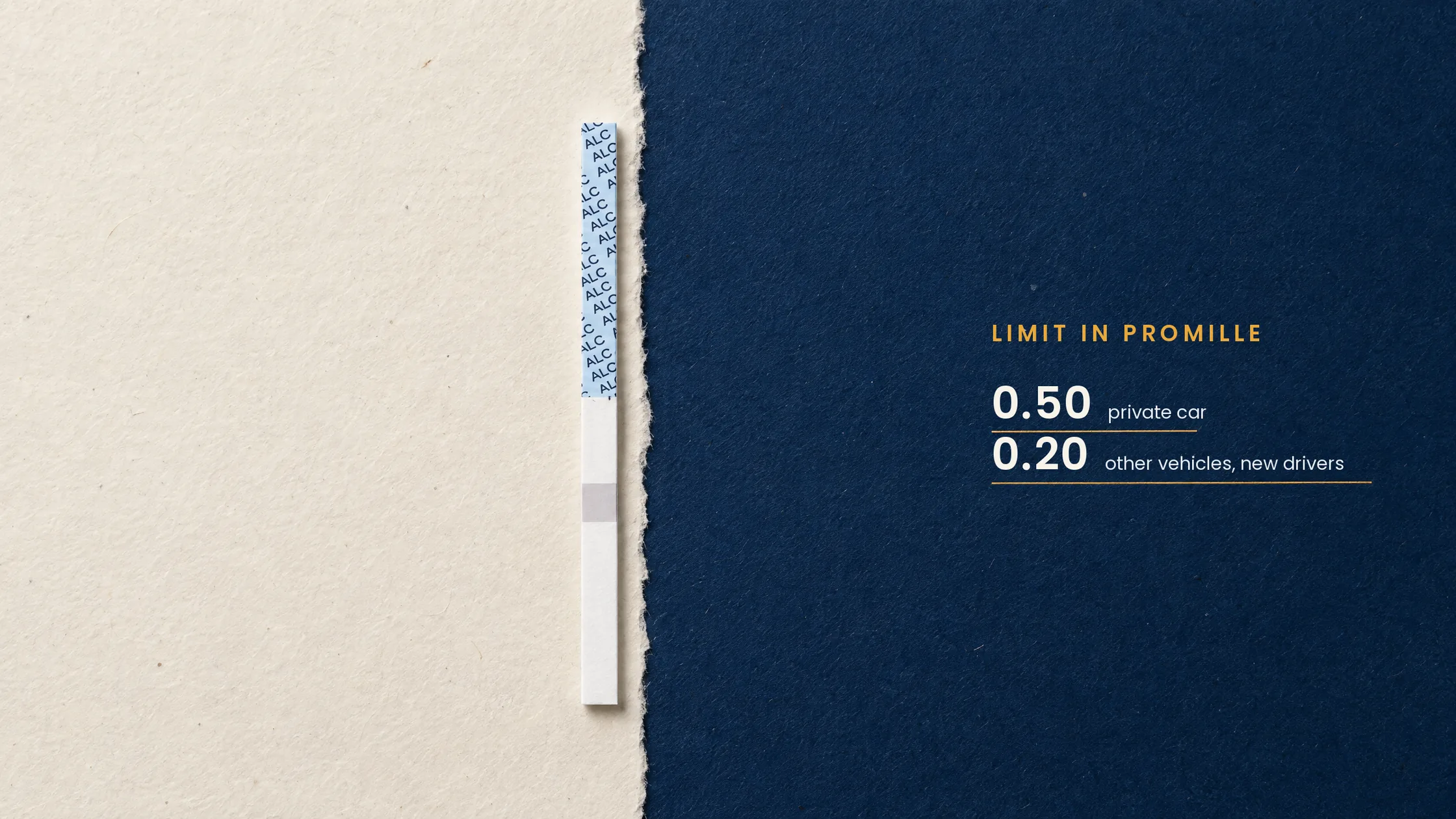
The drink-driving limit in Turkey is 0.50‰ blood alcohol for private cars and 0.20‰ for every other vehicle. Since 27 February 2026 a first offence over 0.50‰ costs 25,000 TL and a six-month licence withdrawal.

A second within five years costs 50,000 TL and two years. A third or later costs 150,000 TL and five years each time. Refusing the roadside measurement costs 150,000 TL and five years. Before February, a first offence was 700 TL.
Why the figures moved this year
This page is written for people driving in Turkey on a foreign licence, usually in a hire car, and for anyone who wants the 2026 figures with the article of law they come from. Turkish limits are stated in promille, written ‰, which is grams of alcohol per litre of blood. The Traffic Department puts 0.50‰ at 0.5 grams of alcohol in a litre of blood, or 50 mg per 100 ml.
Until 27 February 2026 a first drink-driving offence in Turkey cost 700 TL, which is roughly the price of a tank of fuel. Law 7574 replaced that with 25,000 TL and changed article 48 of the Highway Traffic Law in eight separate places on the same day.
Amounts also move every January under the revaluation rule, so any figure you read about Turkish traffic fines needs a date attached to it. Everything below comes from the consolidated statute rather than a summary, with article and paragraph numbers so you can check any line yourself.
The limits
Turkey’s Traffic Department states two limits: 0.50‰ for drivers of private cars, and 0.20‰ for drivers of all other vehicles (Alkollü Araç Kullanımı).
The statute builds the same split from the penalty side. Article 48(5) of Highway Traffic Law 2918 applies a lower threshold of 0.21‰ to drivers of vehicles other than private cars. The limit is 0.20‰ and the penalty starts at 0.21‰.
What is the drink-driving limit in Turkey?
0.50‰ blood alcohol for drivers of private cars and 0.20‰ for drivers of all other vehicles, set by Highway Traffic Law 2918 and stated by Turkey’s Traffic Department. Drivers within their first two Turkish-licensed years are held to 0.20‰ whatever they drive.
Two further thresholds sit on top:
- Above 1.00‰, article 179(3) of the Turkish Penal Code applies in addition to the administrative fine.
- If a private-car driver over 0.50‰, or any other driver over 0.20‰, causes an accident, the relevant provisions of the Penal Code apply as well.
There is also a rule for newly licensed drivers. For the first two years after a Turkish licence is issued, the limit is 0.20‰ regardless of vehicle type, and exceeding it cancels the probationary licence outright. That provision was rewritten by Law 7590 and took effect on 31 July 2026. It attaches to the Turkish probationary licence rather than to a visitor driving on a foreign one.

A hire car driven privately is a private car for these purposes. The category follows the vehicle, not the owner.
The fines
| Situation | Administrative fine | Licence | Source |
|---|---|---|---|
| Over 0.50‰, first offence | 25,000 TL | Withdrawn six months | Law 2918 art. 48(5) |
| Second within five years | 50,000 TL | Withdrawn two years | art. 48(5) |
| Third or later within five years | 150,000 TL | Withdrawn five years each time | art. 48(5) |
| Refusing measurement | 150,000 TL | Withdrawn five years | art. 48(9) |
| Narcotic or stimulant substance | 150,000 TL | Licence cancelled | art. 48(8) |
Amounts are the text in force from 27 February 2026, checked against the consolidated statute on 31 August 2026.
The repeat count runs backwards five years from the most recent offence rather than by calendar year. Where a licence is already suspended for some other reason, the new period starts when the existing one ends.
Law 7574, article 12, changed three figures in one line. The footnote in the consolidated text reads: “700 Türk Lirası” became “25.000 Türk lirası”, “877 Türk Lirası” became “50.000 Türk lirası”, and “1.407 Türk Lirası” became “150.000 Türk lirası”. As multiples, that is roughly 36 times, 57 times and 107 times the previous amounts.
Refusing the test is the expensive option
Article 48(9) was rewritten in the same amendment. A driver who does not submit to measurement by the police faces 150,000 TL and a five-year licence withdrawal.
A first positive test over 0.50‰ is 25,000 TL and six months. Declining the test is 150,000 TL and five years. Refusal costs six times the money and ten times the licence period.
Refusal also does not end the matter. Where a driver is involved in an injury, fatal or police-attended damage-only accident, examination is compulsory. A driver who objects to the technical device is taken to a forensic medicine institution, a forensic physician or a Ministry of Health facility, and blood, saliva or urine samples are taken.
What a foreign visitor should know
Law 7574 added a paragraph to article 115 of Law 2918, in force from 27 February 2026. Administrative fines imposed on a foreign national for traffic violations, which could not be collected before that person left Turkey, are collected when the person next enters the country. If they cannot be collected that way, the foreigner is not permitted to enter.
A separate, older provision in the same article deals with vehicles rather than people. Traffic fines applied to foreign-plated vehicles are collected from the driver without a formal notification requirement, and a foreign-plated vehicle is not permitted to leave Turkey until its traffic fines are collected.
The practical distinction matters if you are on holiday:
- Driving your own car on foreign plates puts you inside both rules. The car does not leave until the fine is settled.
- Driving a Turkish-plated hire car puts you outside the vehicle rule and inside the personal one. An unpaid fine follows you as a person to your next arrival.
An unpaid 25,000 TL fine is therefore not a problem you leave behind at the departure gate.
Getting a licence back
Law 7574 also rewrote article 48(13). A temporarily withdrawn licence can be returned only once all administrative fines issued to that person under this Law have been collected in full.
In practice the clock alone is not enough. One unpaid traffic fine can extend an alcohol suspension past the day it was supposed to end.
Two further obligations sit alongside the waiting period. A driver whose licence is withdrawn for the second time within five years is required to attend driver-behaviour development training. At three or more, psycho-technical evaluation and examination by a psychiatrist are required.
Where a licence is cancelled for narcotics, the route back is longer: driving-school attendance and passing the examinations, and before the course can even begin, at least five years since cancellation, all fines under this Law collected, a psycho-technical evaluation, and a medical board report confirming there is no impediment to driving.
Paying, and the reduction
Two provisions live in two different statutes and both should be read as written.
Article 115 of Law 2918 sets the payment period. If payment is not made immediately, the fine must be paid within one month of service of the notice. Unpaid after that, 5% interest applies per month, and the total cannot exceed twice the fine.
Article 17(6) of Law 5326, the Misdemeanours Law, sets the reduction. Where an administrative fine is paid within its payment period, a 25% reduction is applied. The same paragraph confirms that paying does not affect the person’s right to appeal the decision.
This page does not calculate what any individual will pay and does not work a discounted example. Reduced figures circulating online are drawn from reading those two provisions together, and neither text states a traffic-fine amount. Use the notice you were served and the relevant authority.
There is also annual movement. Under article 17(7) of Law 5326, administrative fines are increased at the start of each calendar year by the official revaluation rate. The amounts here are the text in force from 27 February 2026.
The law now says “test kits”, and whose kits those are
One quieter change deserves a plain answer, because it is easy to misread.
Article 48(2) previously said the police establish drug use or blood alcohol using “technical devices”. Law 7574 changed that phrase to “technical devices/test kits”. The final paragraph of the article was changed the same way: the minimum conditions for the technical devices and test kits used to detect alcohol or narcotics, and the related procedures, are to be set out in a regulation.
The subject of that sentence is law enforcement. A consumer self-check product is not within it, does not substitute for official measurement and produces no legal result. Any product presented as “the test kit named in the law” would be misdescribing itself, and that includes ours.
The decision happens before the engine starts
Everything above describes what happens after you are stopped: how many lira, how many months, which court. The only moment actually in the driver’s hands is the one before that.
At that moment the decision is usually made on a feeling rather than a number. “I’m fine.” “It’s been two hours.” “It was one glass.” Alcohol does not leave the body on a schedule, which we cover separately through what the liver actually does. The morning after a night’s sleep is its own question and has its own page.
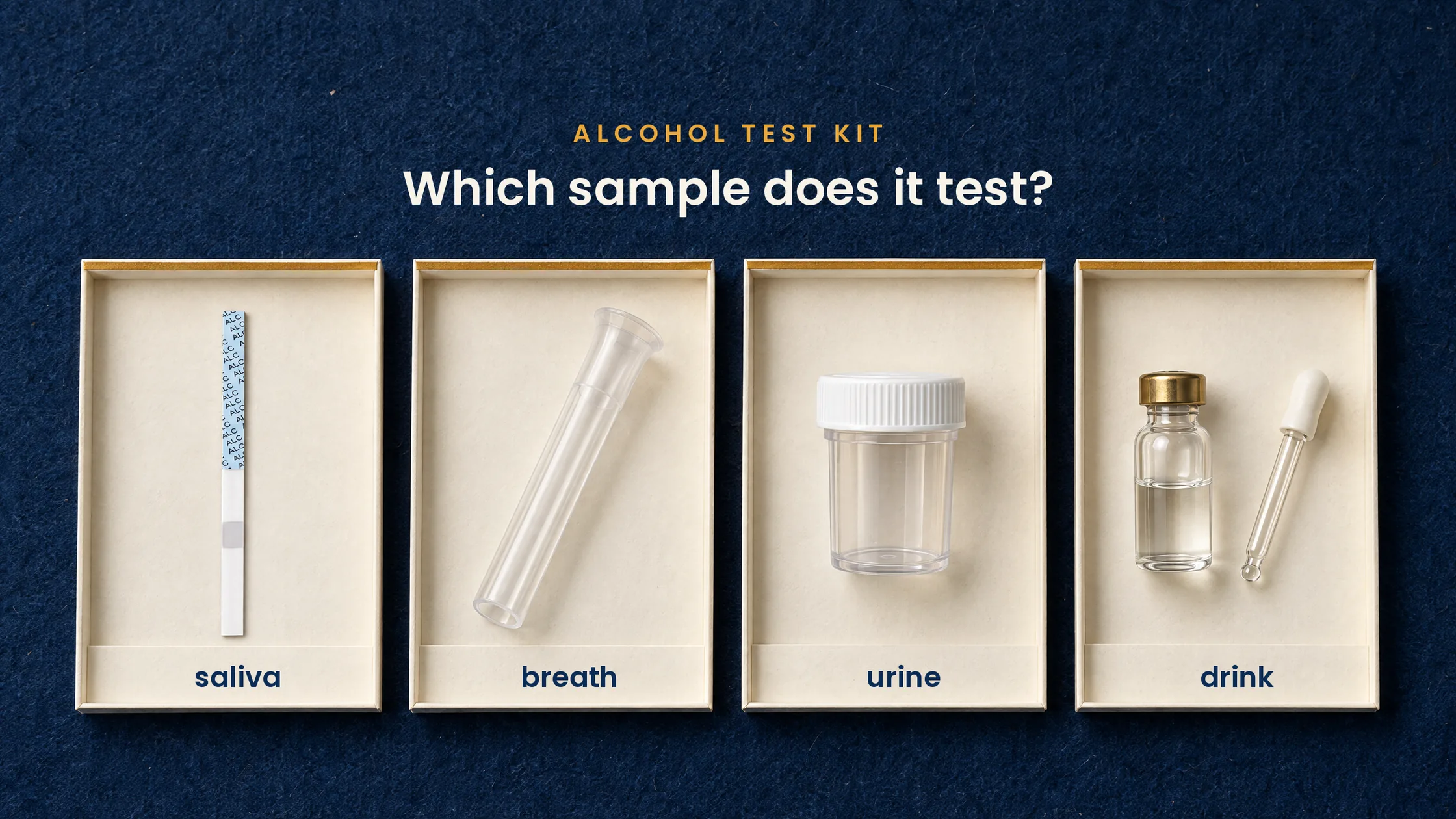
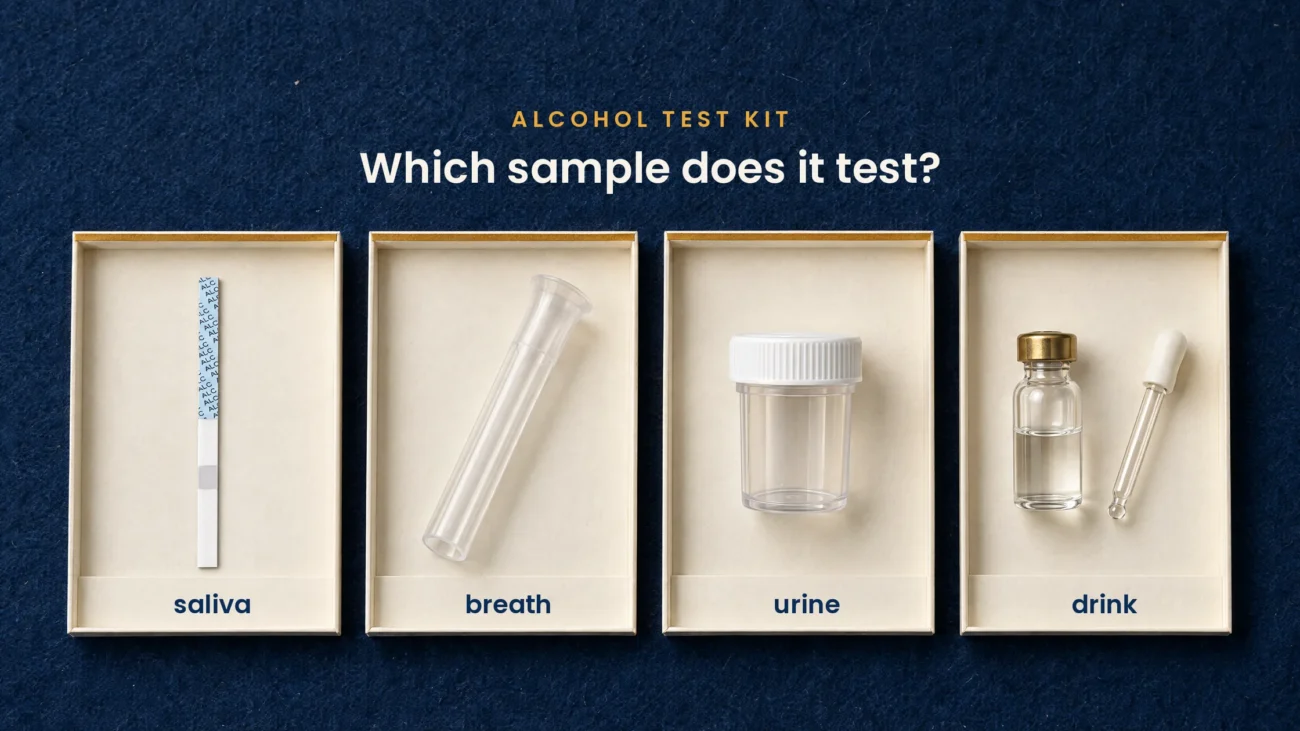
AlkoSafe is a personal saliva screen that looks for alcohol above a 0.2‰ threshold in about two minutes. It is not a police breathalyser, not a blood test, not evidence in court and not a diagnosis. A colour change is not permission.
AlkoSafe is a brand of CROM TEST, a company based in Çankaya, Ankara, Turkey, founded in 2009. Several unrelated companies in Belgium, South Africa and Chile sell alcohol testing products under similar names, so it is worth stating plainly which one this page is about.
What is AlkoSafe?
A personal saliva screen that looks for alcohol in saliva above a 0.2‰ threshold. It is not an official breath or blood test, not a legal basis and not a diagnosis. A negative is not “cleared” and not legal clearance.

What it can add is a second signal at the moment you feel sure of yourself. What it cannot add is a certificate that you are under the limit. If there is any doubt, the answer is the same either way: do not drive.
The wrong decision was already wrong when the fine was 700 TL. What February changed is the price of it.
How the strip is used, and how it compares with a personal breathalyser, is covered in the self-check article.

For a personal check without buying a device: the AlkoSafe saliva alcohol test. Its stated detection threshold is 0.20‰.
- 5 test strips$12.76 $2.55 per stripAdd to cart
- 10 test strips$21.56 $2.16 per stripAdd to cart
- 20 test strips$34.10 $1.71 per stripAdd to cart
Personal saliva screening does not replace an official alcohol test. A negative result does not show that driving is safe.
FAQ
What is the drink-driving limit in Turkey?
0.50‰ for private cars and 0.20‰ for all other vehicles (Traffic Department). The statute applies the threshold from 0.21‰ for non-private vehicles. Drivers in their first two licensed years in Turkey face 0.20‰ regardless of vehicle.
What is the fine for drink-driving in Turkey in 2026?
25,000 TL and six months for a first offence over 0.50‰. Within five years, 50,000 TL and two years for a second, and 150,000 TL and five years each time for a third or later (art. 48(5)).
What happens if I refuse the roadside test in Turkey?
150,000 TL and a five-year licence withdrawal (art. 48(9)). Six times the money and ten times the licence period of a first positive test.
I am a foreign visitor. What if I leave Turkey without paying a traffic fine?
Fines on a foreign national that could not be collected before departure are collected on the next entry to Turkey, and entry is not permitted if they cannot be collected (art. 115, added by Law 7574). A foreign-plated vehicle separately cannot leave until its traffic fines are collected.
Does the limit apply to a hire car?
Yes. A hire car driven privately is a private car at 0.50‰. The exit rule for foreign-plated vehicles does not reach a Turkish-plated hire car; the entry rule for foreign nationals follows the driver.
Is there a discount for paying quickly?
Law 5326 art. 17(6) provides a 25% reduction where the fine is paid within its payment period, which for traffic fines is one month from service (Law 2918 art. 115). This page does not calculate individual amounts.
Do these amounts change?
Yes, every January, by the official revaluation rate (Law 5326 art. 17(7)). The figures here are the text in force from 27 February 2026.
If an AlkoSafe strip is negative, am I clear to drive?
No. It is a personal screen, not an official test, and it carries no legal standing. A colour change is not permission. If you are unsure, do not drive.
Disclaimer
AlkoSafe is a personal screening and self-check tool. It does not replace an official breath test, a blood test, medical advice, an employer rule, or traffic law. A result does not prove you are clear of alcohol or legally in the clear. If you drank, if you are tired or unwell, or if you are not sure, do not drive.
This article is information about Turkish traffic legislation and is not legal advice. It does not cover amnesty, appeals, or any individual case. Amounts and periods are taken from the statute in force and can change during the year. Check the current official source for your own situation, and take legal advice if you need it.
Sources
Official
- Highway Traffic Law 2918, consolidated text (arts. 48, 115, Additional Article 17): https://www.mevzuat.gov.tr/mevzuatmetin/1.5.2918.pdf
- Law 7574 as enacted, Turkish Grand National Assembly (art. 12 amends art. 48 of Law 2918): https://cdn.tbmm.gov.tr/KKBSPublicFile/D28/Y4/KanunMetni/df1886cd-184c-4347-a107-15075f1cc0f3.htm
- Law 5326, Misdemeanours Law (art. 17(6) reduction, art. 17(7) annual revaluation): https://www.mevzuat.gov.tr/mevzuatmetin/1.5.5326.pdf
- Turkish National Police, Traffic Department, Alkollü Araç Kullanımı: https://trafik.gov.tr/alkollu-arac-kullanimi
Commercial
- AlkoSafe product: https://alkosafe.com/alkosafe/
Related
- How long does alcohol stay in your system?
- Driving the morning after
- How to check for alcohol before driving
- How long after drinking can you drive?
- Blood alcohol calculator: scenario range
- AlkoSafe saliva alcohol test
Written and fact-checked by Kazim Altınok, Founder of CROM TEST and AlkoSafe. Last updated 31 August 2026.
AlkoSafe saliva alcohol test
For a personal check without buying a device: the AlkoSafe saliva alcohol test. Its stated detection threshold is 0.20‰.
- 5 test strips$12.76 $2.55 per stripAdd to cart
- 10 test strips$21.56 $2.16 per stripAdd to cart
- 20 test strips$34.10 $1.71 per stripAdd to cart
Personal saliva screening does not replace an official alcohol test. A negative result does not show that driving is safe.

