
A glass of wine has no fixed promille value. A 140 ml glass at 12% contains about 13 grams of alcohol and, in the Widmark model, gives a peak of about 0.17–0.26‰ in a 90 kg man and 0.30–0.52‰ in a 60 kg woman. In the model, a single glass can already reach Turkey’s 0.50‰ limit for one person.
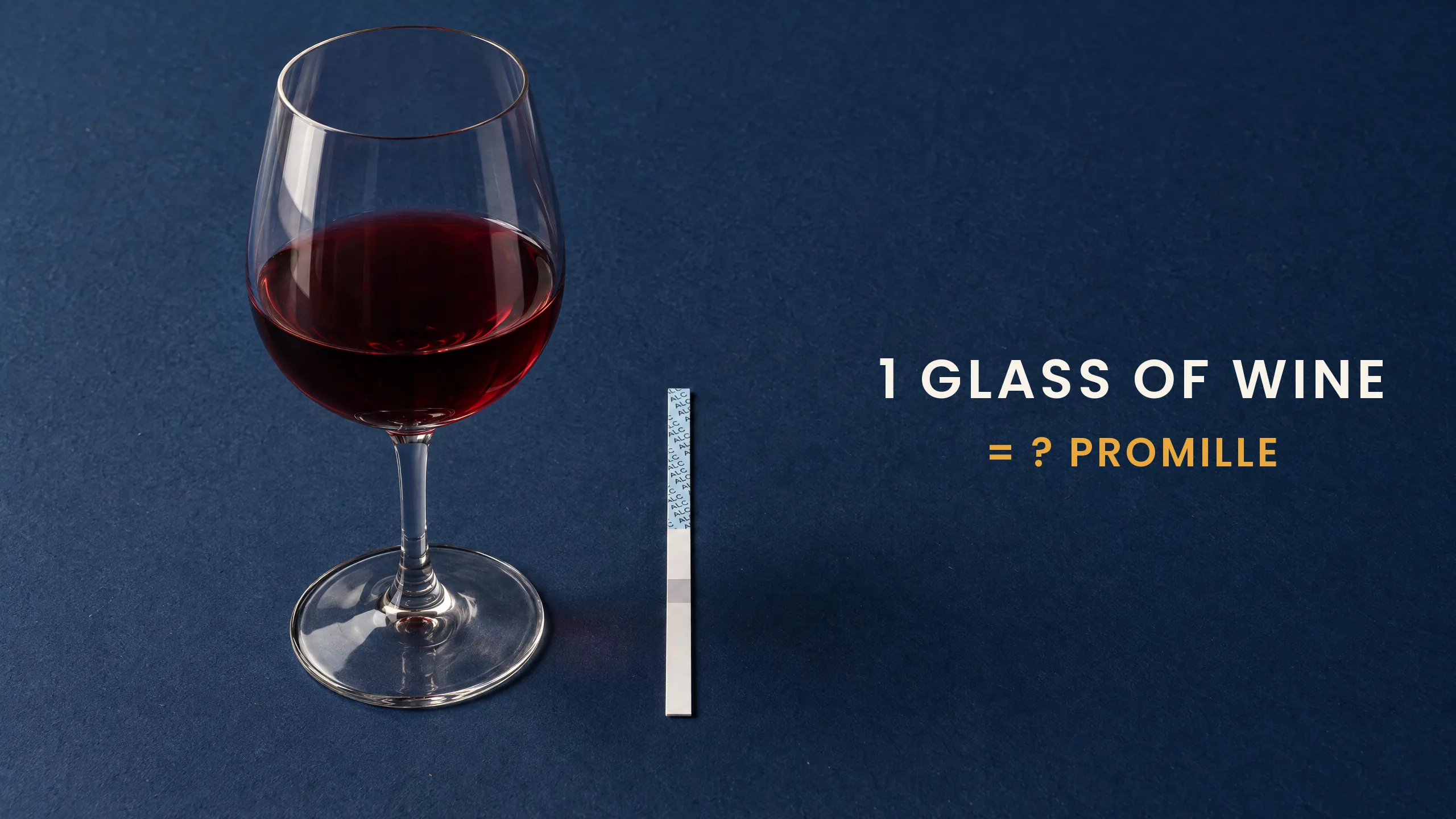
For drivers held to 0.20‰ (drivers of any vehicle other than a private car, and novice drivers in their first two years), one glass can be above the limit, and in the model it is for two of our three example people. A whole bottle lies far above 0.50‰ for everyone. All figures here are model estimates; none of them is a measurement.
This guide explains where the numbers come from, why neither the glass nor the label percentage is fixed, and what one bottle adds up to. It does not tell you how much you can drink before driving, because no count can. It is written for people who drive in Turkey and drink wine with dinner.
How much promille is one glass of wine?
One 140 ml glass of wine at 12% gives a model peak of roughly 0.17 to 0.52‰, depending on who drinks it: 0.17–0.26‰ for a 90 kg man, 0.22–0.33‰ for a 70 kg man and 0.30–0.52‰ for a 60 kg woman. Weight and body water drive the spread; food and time change the real value further. These are model estimates, not measurements.
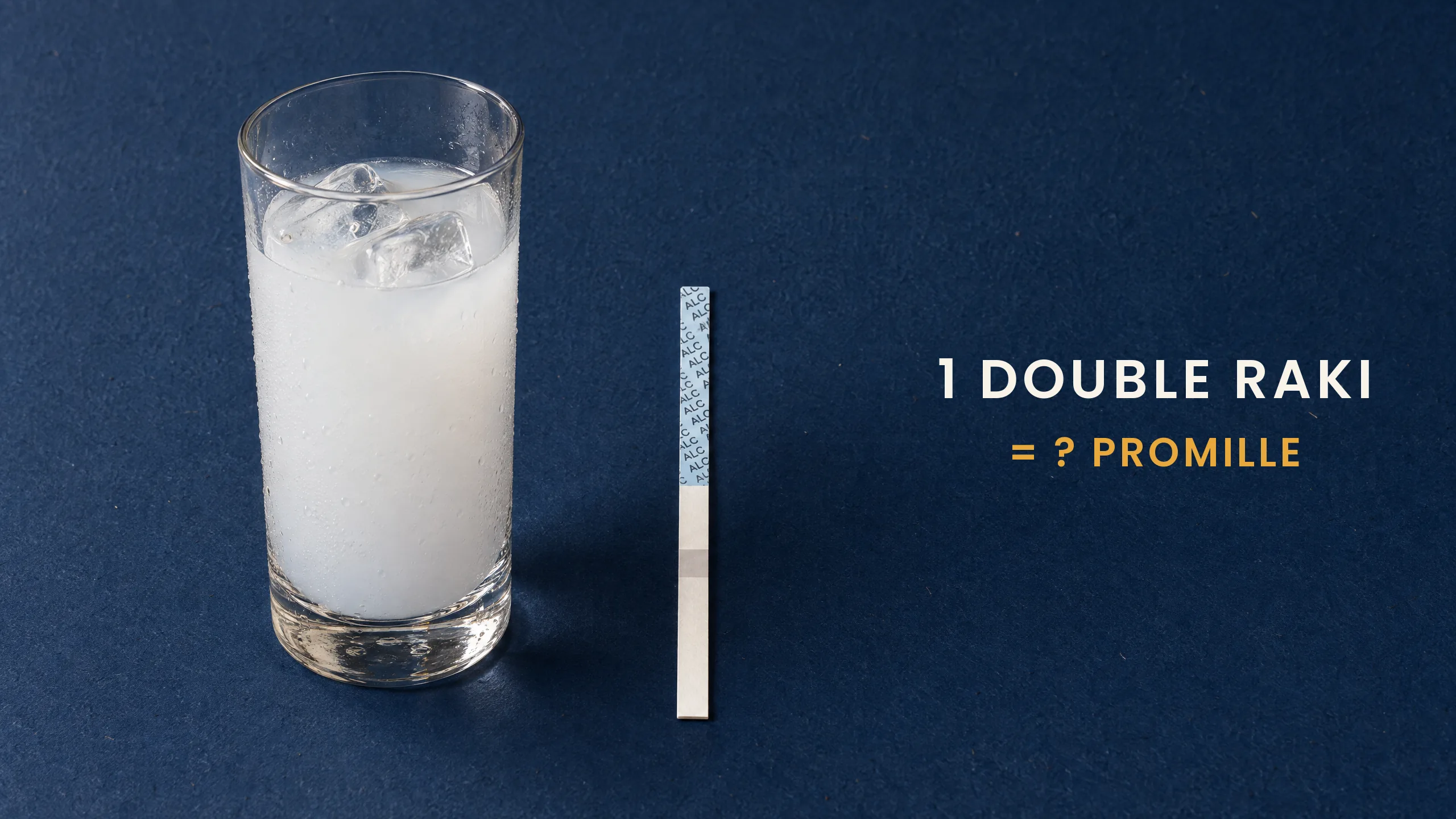
A Turkish addiction-medicine guide counts one glass of wine (140 ml at 12%) as one standard drink, the same as a small beer or a single rakı; in Turkey a standard drink holds 12–14 grams of alcohol (Üsküdar University).
The alcohol in a drink is its volume × alcohol percentage × 0.789, the density of ethanol in grams per millilitre (Searle 2015). A 140 ml glass at 12% holds about 13 grams of alcohol.
To turn grams into promille, the Widmark model divides the alcohol by body weight × a distribution volume, the share of the body the alcohol spreads into. A current forensic standard gives population ranges of 0.58–0.83 L/kg for men and 0.43–0.73 L/kg for women (ANSI/ASB 122, 2024; Maskell et al. 2023). One promille means one gram of alcohol per litre of blood, the unit the Turkish limits use (Turkish Traffic Department). In BAC terms, 0.50‰ equals 0.05%. More on the unit: what does promille mean.
Formula: alcohol (g) = volume (ml) × ABV × 0.789; promille ≈ alcohol (g) ÷ [weight (kg) × distribution volume (L/kg)].
The model peak for one and two glasses of wine, assuming all the alcohol is absorbed and none is broken down yet:
| Person (model) | 1 glass (140 ml, 12%) | 2 glasses (280 ml, 12%) |
|---|---|---|
| Man, 90 kg | 0.17–0.26‰ | 0.35–0.51‰ |
| Man, 70 kg | 0.22–0.33‰ | 0.45–0.66‰ |
| Woman, 60 kg | 0.30–0.52‰ | 0.60–1.03‰ |
Our own calculation with the formula above, rounded outward to two decimals. The ranges are wide because the model does not know your body composition, only your sex and weight. You can see the range for your own weight, glass and label in the blood alcohol calculator.
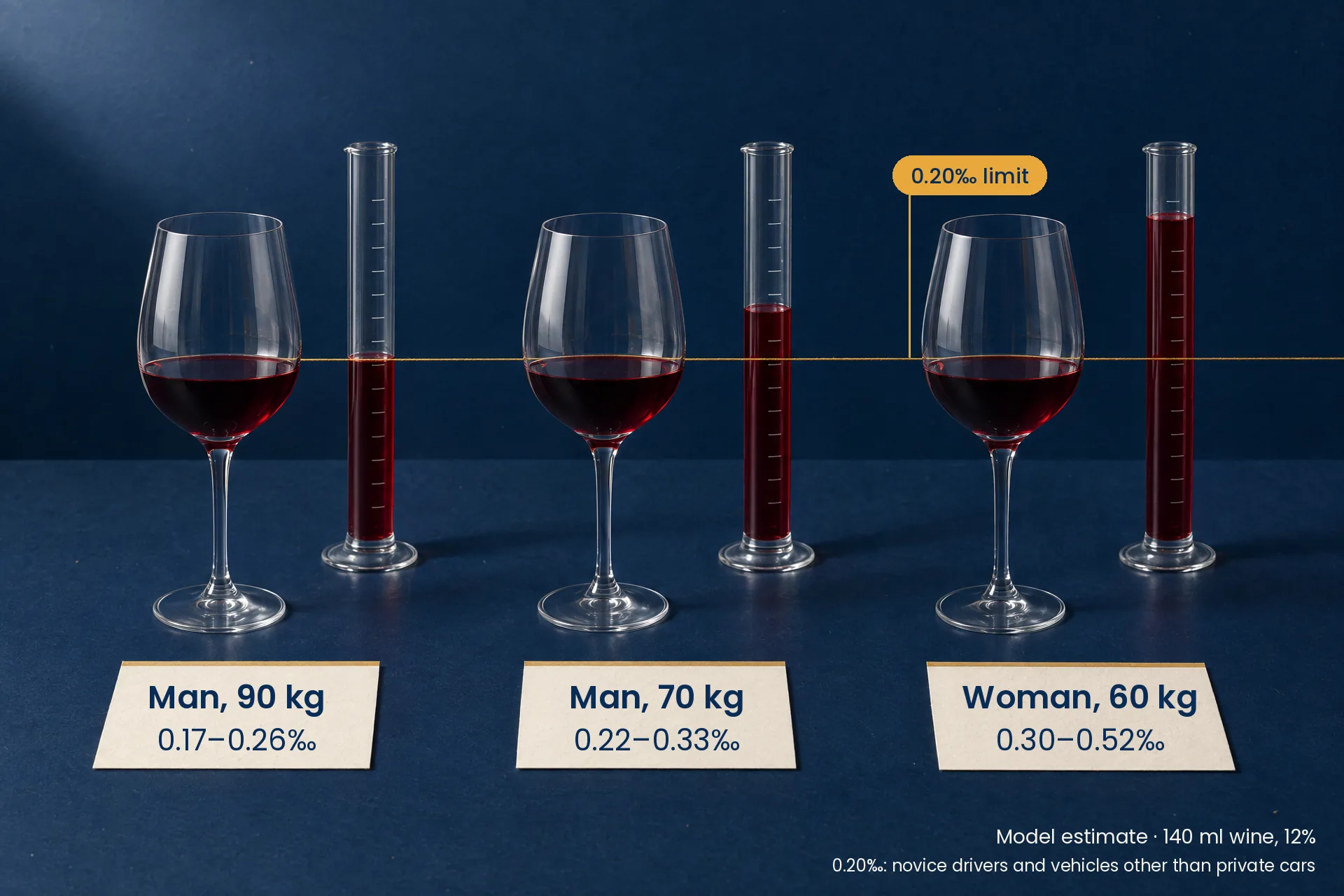
The table shows three things. First, one glass is above 0.20‰ for the 70 kg man and the 60 kg woman, and the 90 kg man’s range spans 0.20‰. Second, the woman’s upper value for one glass (0.52‰) passes 0.50‰. Third, two glasses span 0.50‰ for both men and lie entirely above it for the woman, whose upper value (1.03‰) passes 1.00‰.
The model assumes full absorption and leaves out food and time. Both change the real number, as the sections below show.
How much promille are two glasses of wine?
Two 140 ml glasses hold about 27 grams of alcohol. In the model that gives a peak of 0.35–0.51‰ for a 90 kg man, 0.45–0.66‰ for a 70 kg man and 0.60–1.03‰ for a 60 kg woman. Three glasses (about 40 grams) lie entirely above 0.50‰ for all three: 0.53–0.77‰, 0.68–0.98‰ and 0.90–1.55‰.
The Turkish Traffic Department warns that beer and wine are often drunk in larger amounts because people think of them as “light” drinks (Turkish Traffic Department).
How much promille is a bottle of wine?
A 75 cl bottle at 12% holds about 71 grams of alcohol, about five 140 ml glasses or five and a half small beers. If one person drinks it all, the model peak is 0.95–1.37‰ for a 90 kg man, 1.22–1.75‰ for a 70 kg man and 1.62–2.76‰ for a 60 kg woman. All three ranges lie entirely above 0.50‰, and above 1.00‰, Turkish criminal law applies on top of the fine (see below).
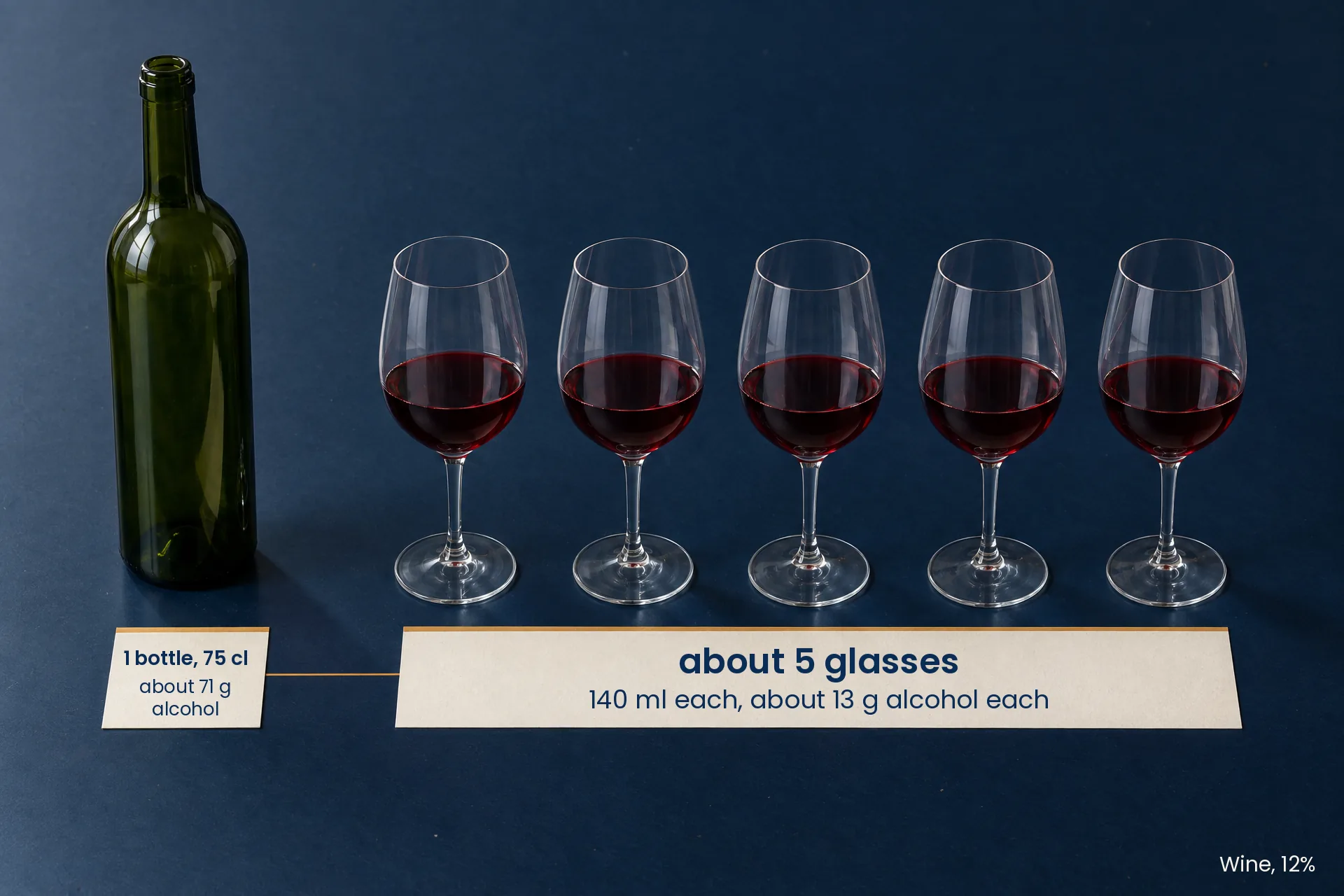
Drinking the bottle over an evening lowers the peak, because the body breaks some alcohol down along the way, but almost all of the 71 grams still have to be broken down by the liver. Half a bottle (37.5 cl, about 36 grams) gives 0.47–0.69‰ for a 90 kg man in the model.
How big is a glass of wine, and how strong?
The Turkish guide counts a glass of wine as 140 ml at 12%. A glass (kadeh) is still not a fixed measure: the Turkish dictionary defines it as the glass and the amount it holds (TDK). Some calculators use 150 ml, and a generous restaurant pour can be larger. The percentage on the label changes the result too.
| One glass | Pure alcohol | 90 kg man | 70 kg man | 60 kg woman |
|---|---|---|---|---|
| 140 ml, 12% | about 13 g | 0.17–0.26‰ | 0.22–0.33‰ | 0.30–0.52‰ |
| 150 ml, 12% | about 14 g | 0.19–0.28‰ | 0.24–0.35‰ | 0.32–0.56‰ |
| 140 ml, 14% (example) | about 15 g | 0.20–0.30‰ | 0.26–0.39‰ | 0.35–0.60‰ |
| 200 ml, 12% (example) | about 19 g | 0.25–0.37‰ | 0.32–0.47‰ | 0.43–0.74‰ |
Model peaks, our calculation with the formula above, rounded outward. Red, white and rosé give the same result at the same volume and percentage. Read the percentage on your bottle and estimate the millilitres in your glass.
What affects promille when you drink wine? Five factors
The same glass of wine gives two people different promille. Five factors decide the difference: the amount of alcohol, body weight, body water, food in the stomach and time.
- Amount and strength. A larger pour or a stronger wine means more grams. Count millilitres and read the label.
- Body weight. The same alcohol spreads into a larger body and gives a lower concentration.
- Body water. Alcohol dissolves in water, not fat. Women on average have less body water per kilogram, which is why the female range starts lower (0.43 L/kg) and gives higher promille for the same drink (ANSI/ASB 122).
- Food in the stomach. In a crossover study, ten men drank the same dose after an overnight fast and after breakfast. The average peak was 1.04‰ on an empty stomach and 0.67‰ after the meal (Jones & Jönsson 1994, PMID 8064267). Wine with dinner lowers the peak; it does not remove the alcohol.
- Time. Absorption can take up to about two hours (ANSI/ASB 122), so blood alcohol can still rise after the last glass. After that, blood alcohol falls by roughly 0.10–0.20‰ per hour, often near 0.15 (Jones 2010, PMID 20304569). Coffee, exercise or a short nap do not speed this up; that takes the liver and time (Turkish Traffic Department). More in our guide how long alcohol stays in your system.
Wine, beer and rakı: how many grams of alcohol in one serving?
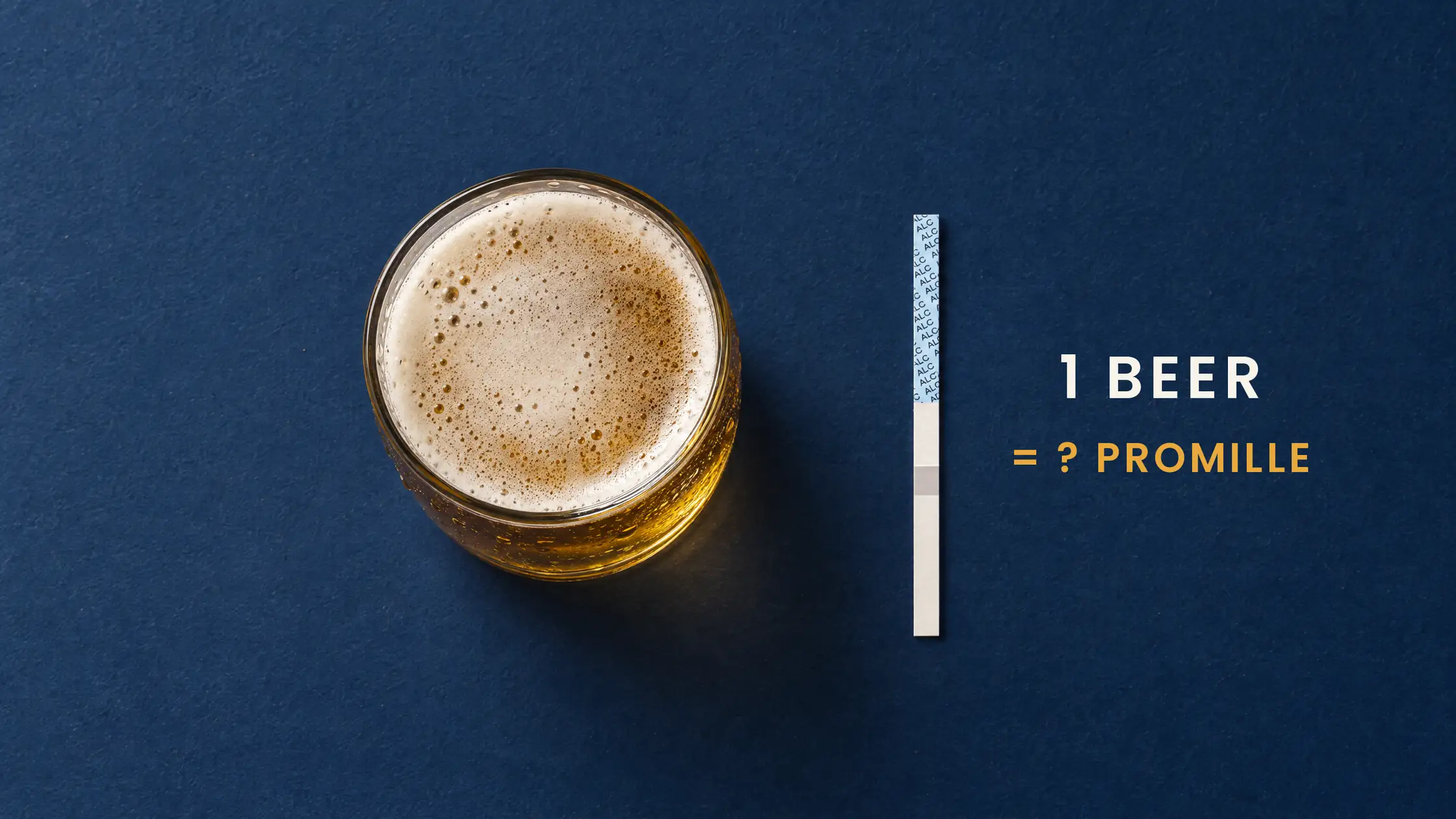
A glass of wine, a small beer and a single rakı hold almost the same amount of alcohol. Using the serving sizes of the Turkish guide (Üsküdar University):
| Drink | Serving | Alcohol | Pure alcohol |
|---|---|---|---|
| Wine, glass | 140 ml | 12% | about 13 g |
| Wine, bottle | 750 ml | 12% | about 71 g |
| Beer | 330 ml | 5% | about 13 g |
| Rakı, single | 40 ml | 45% | about 14 g |
The bottle row is our arithmetic for a 75 cl bottle; the other servings are from the guide. What one beer does in the model is explained in how much promille is one beer, and rakı in how much promille is a double rakı.
What is the legal limit in Turkey?
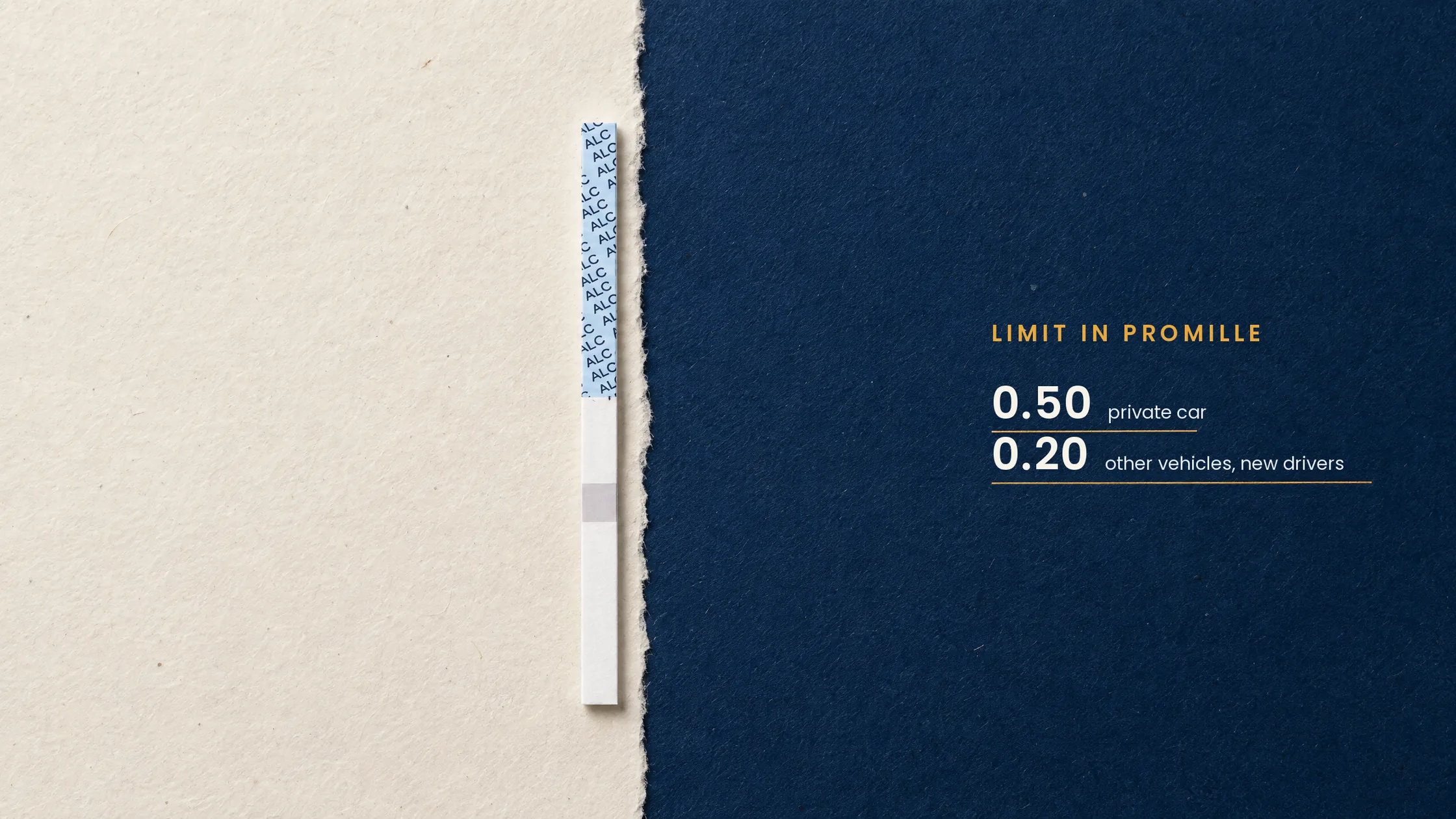
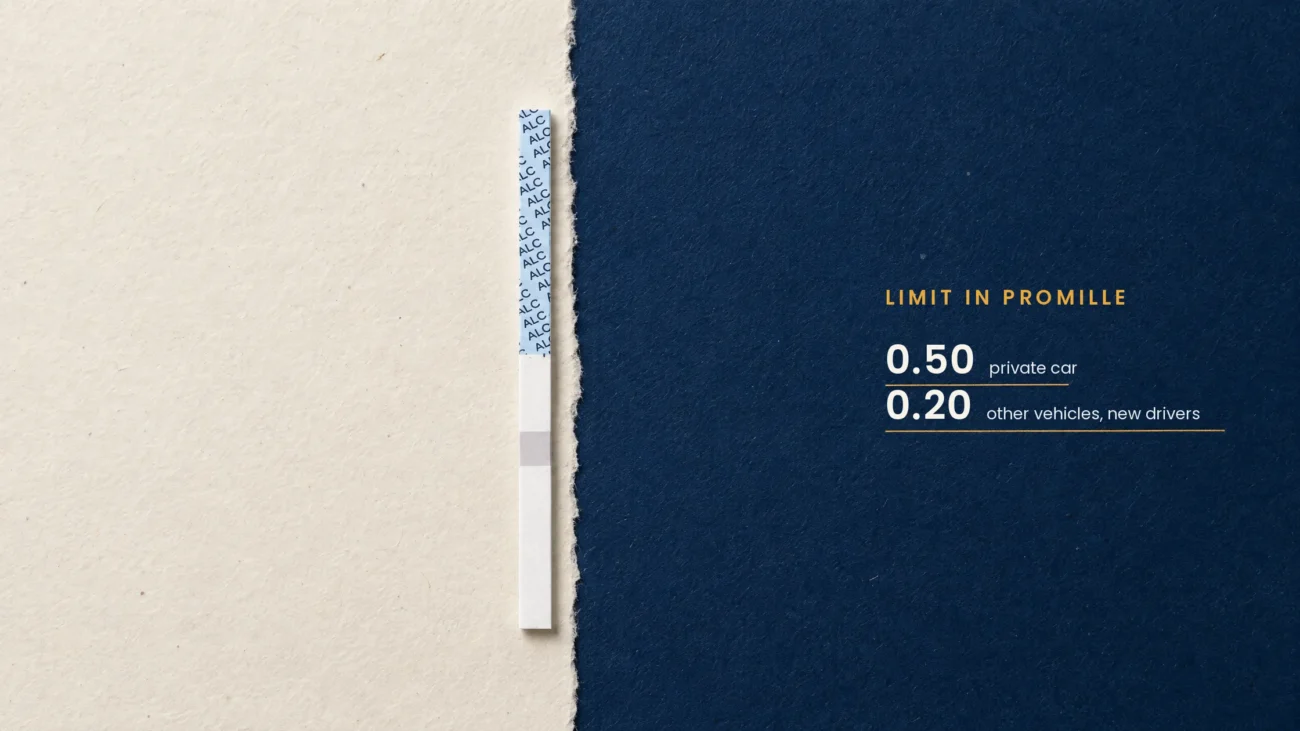
In Turkey the drink-driving limit is 0.50‰ for private-car drivers and 0.20‰ for drivers of all other vehicles (Turkish Traffic Department). Novice drivers are held to 0.20‰ in any vehicle during their first two licensed years; above it, the novice licence is cancelled (Law 2918, Additional Article 17). A first offence above 0.50‰ in a private car, or above 0.20‰ in any other vehicle, means a 25,000 TL fine and six months without a licence (Law 2918, art. 48(5); amount in force since 27 February 2026). Above 1.00‰, Article 179(3) of the Turkish Penal Code applies in addition to the administrative fine (Law 2918). Penalties, repeat offences and refusing the test are explained in drink-driving limits and fines in Turkey.
Promille estimate or measurement?
Counting glasses is an estimate, and so is a calculator. Our blood alcohol calculator uses the same model as this article: you enter drinks, weight and time, and it gives a range, not a verdict.
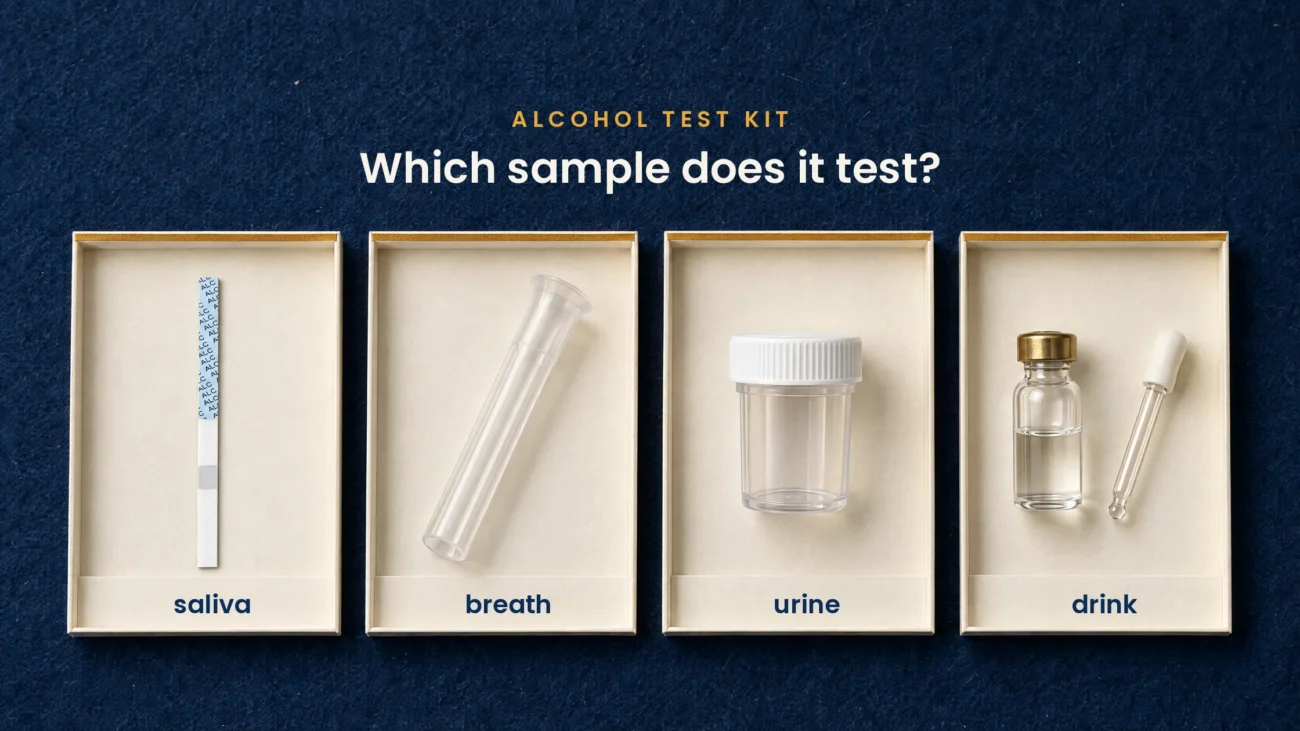
If you want a signal from your own body instead of an estimate, a saliva test checks the alcohol in your saliva instead of counting. Ethanol passes from blood into saliva, and in a study of 48 men saliva alcohol followed blood alcohol closely, at about 1.08 times the blood value (Jones 1979, PMID 761427). That describes saliva, not the accuracy of any strip. AlkoSafe is a saliva screening strip with a stated detection threshold of 0.20‰ (manufacturer statement); how it turns alcohol into a colour is explained on how AlkoSafe works.

For a personal check without buying a device: the AlkoSafe saliva alcohol test. Its stated detection threshold is 0.20‰.
- 5 test strips$12.76 $2.55 per stripAdd to cart
- 10 test strips$21.56 $2.16 per stripAdd to cart
- 20 test strips$34.10 $1.71 per stripAdd to cart
Personal saliva screening does not replace an official alcohol test. A negative result does not show that driving is safe.
What no count can tell you
No glass count, calculator or test result tells you that you are fit to drive. Alcohol affects reaction and judgement below the legal limit too, and the Turkish Traffic Department states that there is no safe alcohol limit for driving (Turkish Traffic Department). If you have been drinking, do not drive. Take a taxi, public transport or a driver who has not been drinking.
Frequently asked questions
Does one glass of wine raise your blood alcohol?
Yes. In the Widmark model, one 140 ml glass at 12% gives a peak of about 0.17–0.52‰ across our example adults: 0.17–0.26‰ for a 90 kg man and 0.30–0.52‰ for a 60 kg woman. Whether a roadside test finds a value above your limit depends on that value and on your limit, not on the glass count.
How much wine is 0.50 promille?
There is no fixed amount. In the model, one glass already reaches 0.30–0.52‰ for a 60 kg woman, and two glasses span 0.50‰ for a 70 kg and a 90 kg man. The same count means different concentrations in different bodies, and no count guarantees that you stay under the limit.
How much promille are two glasses of wine?
In the model, two 140 ml glasses at 12% give 0.35–0.51‰ for a 90 kg man, 0.45–0.66‰ for a 70 kg man and 0.60–1.03‰ for a 60 kg woman. All three ranges include values above 0.50‰.
How much promille is a bottle of wine?
A 75 cl bottle at 12% holds about 71 grams of alcohol. If one person drinks it all, the model gives 0.95–1.37‰ for a 90 kg man, 1.22–1.75‰ for a 70 kg man and 1.62–2.76‰ for a 60 kg woman, all entirely above 0.50‰.
How many glasses are in a bottle of wine?
A 75 cl bottle holds about five 140 ml glasses (750 ÷ 140 = 5.4). With larger glasses it is fewer, with the same alcohol in total.
How many beers is a bottle of wine?
In alcohol, a 75 cl bottle of 12% wine (about 71 g) equals about five and a half small 33 cl beers at 5%, or three and a half 50 cl beers. See how much promille is one beer.
Can one glass of wine get you fined?
It depends on the measured value and your licence, not on the number of glasses. Private car drivers face penalties above 0.50‰; other drivers and novice drivers above 0.20‰, which one glass passes for two of our three example people in the model. See limits and fines in Turkey.
How much promille does the body remove per hour?
Blood alcohol falls by roughly 0.10–0.20‰ per hour, often near 0.15 (Jones 2010). The rate varies between people and absorption can take up to two hours, so this rate cannot tell you when you can drive. More in how long alcohol stays in your system.
About this guide
This guide was written from the sources listed below, checked on 7 October 2026. The promille ranges are our own calculations with the published Widmark model and the distribution volumes of ANSI/ASB 122, the same model our calculator and our beer guide use. Serving sizes follow the Üsküdar University guide; legal limits follow the Turkish Traffic Department and the current text of Law 2918.
Disclaimer
AlkoSafe is a personal screening and self-check product. It does not replace an official breath test, a blood test, medical advice, employer rules or traffic law. A test result does not prove that you are free of alcohol or legally fit to drive. If you have been drinking, feel tired or unwell, or are unsure, do not drive.
Sources
Official
- Turkish Traffic Department (EGM Trafik Başkanlığı), Alkollü Araç Kullanımı: https://trafik.gov.tr/alkollu-arac-kullanimi
- Law 2918 on Road Traffic, current text (art. 48, Additional Article 17): https://www.mevzuat.gov.tr/mevzuatmetin/1.5.2918.pdf
- TDK Güncel Türkçe Sözlük, “kadeh”: https://sozluk.gov.tr/
- ANSI/ASB Best Practice Recommendation 122, final 2024 (distribution volumes §4.1.3.2, absorption §4.1.2): https://www.aafs.org/sites/default/files/media/documents/122_BPR_e1.pdf
Studies
- Maskell PD et al. Population ranges for the volume of distribution (Vd) of alcohol for use in forensic alcohol calculations. J Forensic Sci. 2023. DOI 10.1111/1556-4029.15317. https://eprints.gla.ac.uk/301086/1/301086.pdf
- Searle J. Alcohol calculations and their uncertainty. Med Sci Law. 2015;55(1):58–64. PMID 24644224. https://journals.sagepub.com/doi/10.1177/0025802414524385
- Jones AW, Jönsson KA. Food-induced lowering of blood-ethanol profiles and increased rate of elimination immediately after a meal. J Forensic Sci. 1994. PMID 8064267
- Jones AW. Evidence-based survey of the elimination rates of ethanol from blood with applications in forensic casework. Forensic Sci Int. 2010. PMID 20304569
- Jones AW. Distribution of ethanol between saliva and blood in man. Clin Exp Pharmacol Physiol. 1979. PMID 761427
- Eryılmaz G, Dilbaz N. Alkol Kullanım Bozukluğu Tanısı Konulmuş Hastaların Aileleri İçin Rehber. Üsküdar University Press (serving sizes and standard drink, p. 20). https://uuyayinlari.com/download/77
Manufacturer
- AlkoSafe product page (detection threshold 0.20‰): https://alkosafe.com/alkosafe/
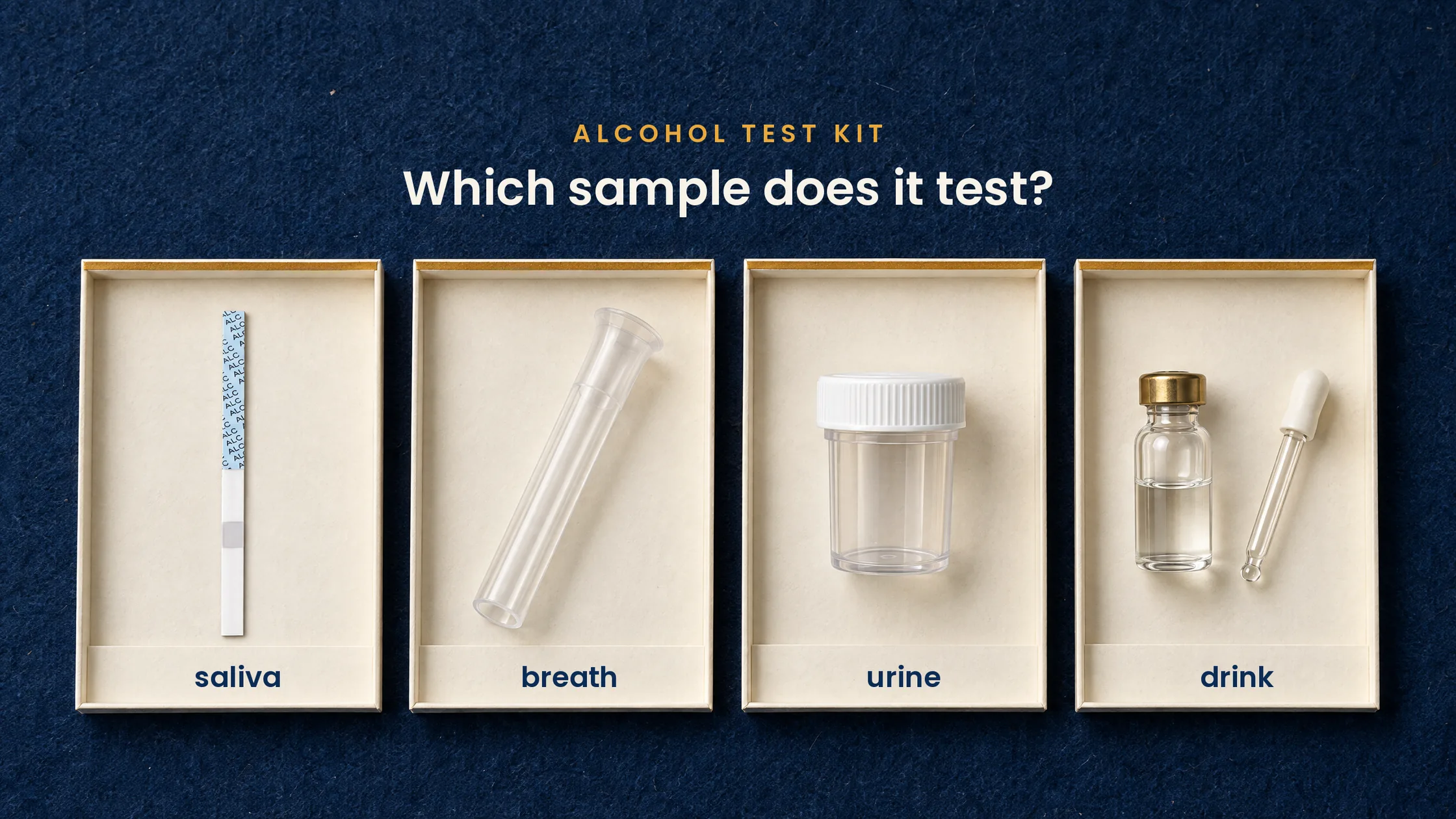
AlkoSafe saliva alcohol test
For a personal check without buying a device: the AlkoSafe saliva alcohol test. Its stated detection threshold is 0.20‰.
- 5 test strips$12.76 $2.55 per stripAdd to cart
- 10 test strips$21.56 $2.16 per stripAdd to cart
- 20 test strips$34.10 $1.71 per stripAdd to cart
Personal saliva screening does not replace an official alcohol test. A negative result does not show that driving is safe.

